As water and wastewater treatment professionals at Ionic Engineering Technology Pvt. Ltd., we spend countless hours engineering detailed techno-commercial proposals. We analyse feed water chemistry, select the precise membrane technologies, and present a value-engineered solution designed for long-term reliability. We provide extensive technical justification to show exactly why a specific design is necessary to reduce your facility's water and energy footprint.
Yet, time and again, we watch the customer's decision-making process devolve into a single, flawed metric: Lowest CAPEX.
In the drive to cut initial capital expenditure, crucial technical details are ignored. The focus shifts away from the final project outcome — stable water quality, high recovery, and minimal downtime — and instead becomes a race to the bottom on price. This casual approach to procurement is financially dangerous for the plant.
As the concept of the Feedback Failure Loop illustrates, cheap decisions in water treatment inevitably become expensive operations. Here is why lifecycle thinking is an engineering responsibility.
The Assumption vs. Reality Split
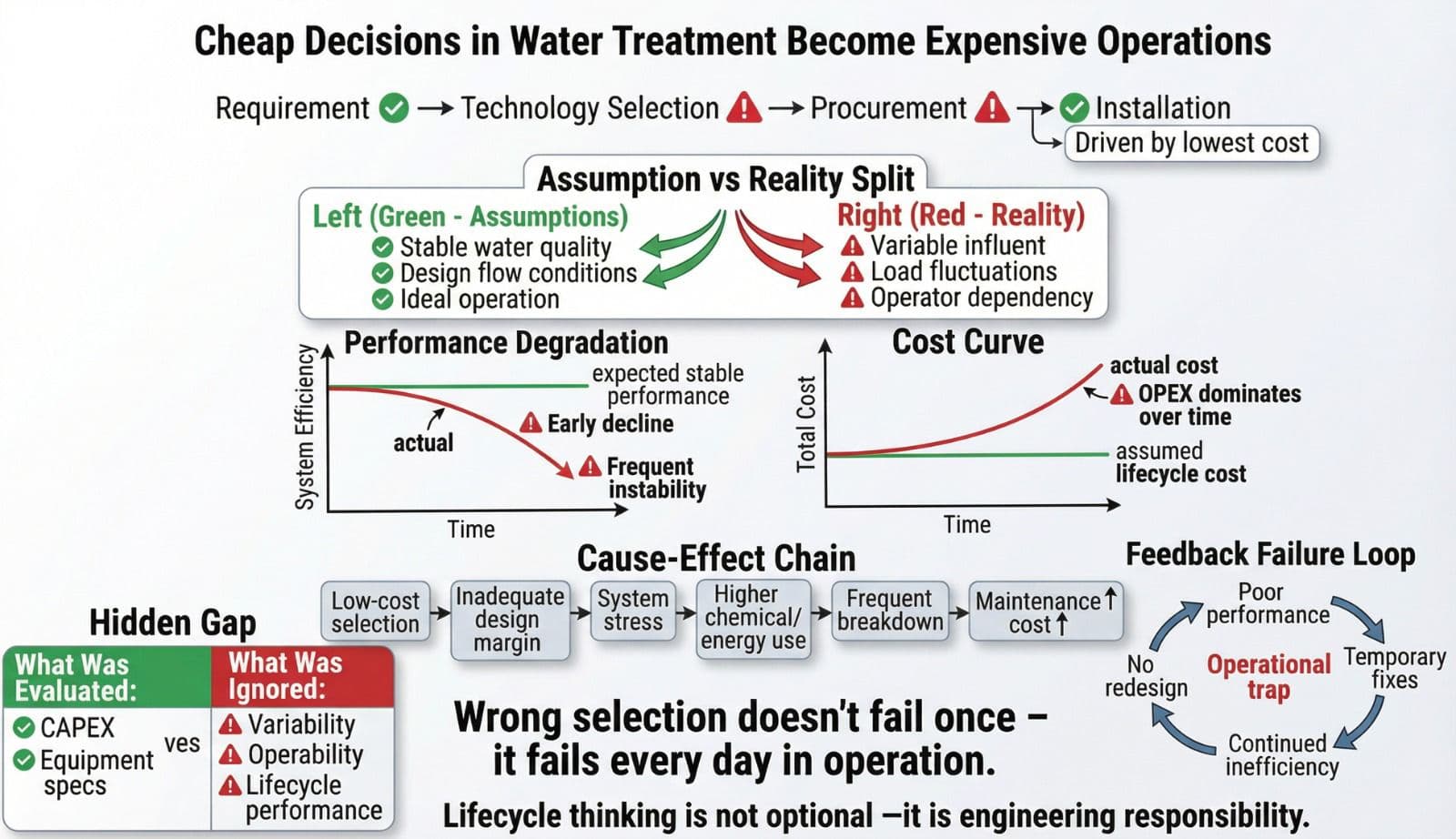
When a plant is purchased based solely on the lowest CAPEX and basic equipment specs, the buyer is making a dangerous assumption. They are assuming perfectly stable feed water quality, consistent design flow conditions, and ideal, error-free operation.
But the reality of industrial water treatment is unforgiving. Influent is variable. Load fluctuations happen daily. A budget-engineered, low-CAPEX system lacks the design margins and robust automation required to absorb these real-world shocks.
The Performance Degradation Trap
What happens when a stripped-down, low-cost system meets operational reality? We see an immediate performance degradation curve.
Instead of expected stable performance, the system experiences an early decline and frequent instability. Because the system was designed with inadequate margins to save upfront costs, it operates under constant stress. This kicks off a predictable cause-and-effect chain:
The cause-and-effect chain
- Low-cost selection leads to inadequate design margin
- Inadequate design margin causes system stress
- System stress drives higher chemical and energy consumption
- Higher consumption triggers frequent breakdowns
- Frequent breakdowns produce skyrocketing maintenance costs
The OPEX Dominance Over Time
The most tragic part of the low-CAPEX trap is the cost curve. Procurement may celebrate saving 15% on the initial purchase price, but in water treatment CAPEX typically accounts for only a fraction of the total lifecycle cost. OPEX — driven by energy, chemicals, membrane replacements, and labour — makes up the rest.
When a system runs inefficiently, OPEX compounds rapidly. Over a 5-to-10-year operating horizon, the actual total cost of the 'cheap' plant violently overtakes the assumed lifecycle cost. A dollar saved in CAPEX often results in ten dollars lost in OPEX and production downtime.
Breaking the Feedback Failure Loop
Once a plant is trapped in this cycle, operators are forced into a loop of poor performance and temporary fixes, resulting in continued inefficiency.
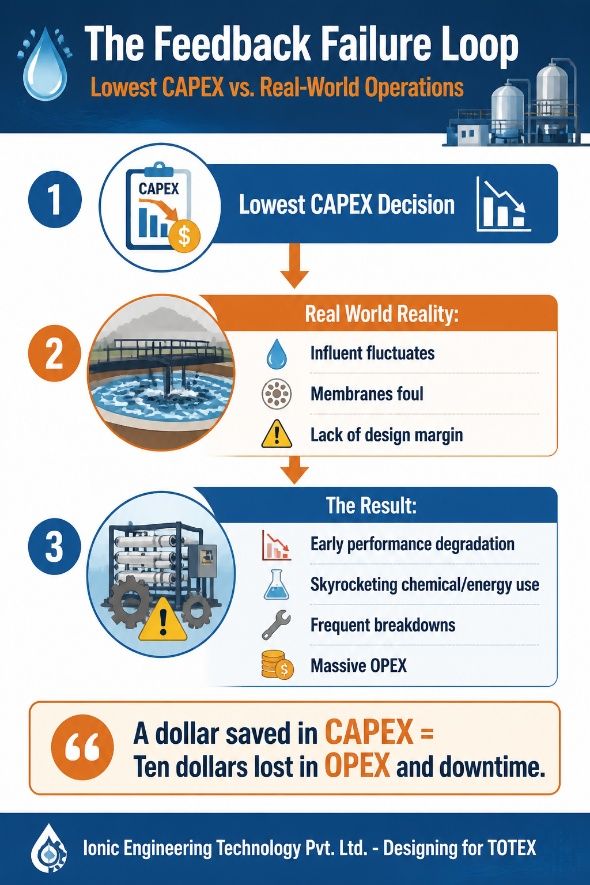
The Feedback Failure Loop — a low-CAPEX water treatment decision leads to real-world reality (variable influent, fouling, lack of design margin) and ultimately massive OPEX
At Ionic Engineering Technology Pvt. Ltd., we refuse to play this game. We believe that a wrong selection doesn't just fail once during commissioning — it fails every single day in operation.
When we design a system — whether it is a Reverse Osmosis (RO) plant, a Demineraliser, a Zero Liquid Discharge (ZLD) facility, or an intelligent dosing system — we design for Total Expenditure (TOTEX). We look at your specific process realities to optimise specific energy consumption and maximise recovery.
Engineering for TOTEX, not CAPEX
We urge plant managers and procurement teams to look beyond the initial price tag. Ask the hard questions about asset life, reliability, efficiency, ease of maintenance, operation, process monitoring, and control, specific energy consumption, chemical dosing rates, and expected membrane life. Evaluate the engineering, not just the component and equipment list. Because in water treatment, you don't pay for the plant you buy — you pay for the plant you operate.
Ready to engineer a smarter solution? Explore our advanced treatment technologies and discover how we transform unique water challenges into sustainable, economical advantages.
Frequently asked questions
What is the difference between CAPEX and OPEX in a water treatment plant?
CAPEX (capital expenditure) is the one-time cost to procure and install the plant — equipment, civil work, commissioning. OPEX (operating expenditure) is the recurring cost to run it — energy, chemicals, membrane replacements, labour, and maintenance. Over a 5-to-10-year horizon, OPEX in water treatment usually dwarfs CAPEX, often by an order of magnitude when the plant is poorly designed.
Why does the lowest-CAPEX water treatment system often cost more long-term?
A lowest-CAPEX system is typically sized with thin design margins and basic automation. When real influent fluctuates or load shifts, the plant runs under stress: efficiency drops early, chemical and energy use rises, breakdowns become frequent, and maintenance costs spiral. The savings on day one are often paid back many times over in OPEX and downtime within the first few years.
What is TOTEX in water treatment plant design?
TOTEX (total expenditure) is the sum of CAPEX and OPEX over the asset's life. Designing for TOTEX means optimising specific energy consumption, recovery, membrane life, and maintainability up front, even if it raises CAPEX modestly, because it lowers the much larger lifecycle cost. It is the engineering-responsible alternative to procurement-driven lowest-CAPEX selection.
What questions should I ask before procuring a water or wastewater treatment plant?
Ask about asset life and warranties, design margin against influent variability, specific energy consumption per cubic metre treated, chemical dosing rates per cubic metre, expected membrane life and replacement intervals, ease of maintenance, level of process monitoring and automation, recovery percentage, and reliability metrics. Evaluate the engineering and operating philosophy — not just the equipment list and the bottom-line price.
How does a Feedback Failure Loop trap water treatment operators?
Poor performance forces temporary fixes (extra dosing, manual intervention, partial shutdowns) instead of redesign. Because the underlying capacity and automation gap is never addressed, inefficiency continues, OPEX grows, and the operator stays trapped chasing symptoms. Breaking the loop requires re-evaluating the original engineering against real operational data — usually pointing to a redesign or upgrade for the right TOTEX.